Your Trusted Carbon Fiber Rackets & Composites Parts Manufacturer.

Views: 0 Author: Site Editor Publish Time: 2026-10-26 Origin: Site

The accelerating migration of tennis players to padel often brings a false assumption that equipment mechanics translate directly across both sports. Applying tennis racquet selection criteria to padel gear results in mismatched equipment. This leads to compromised biomechanics, reduced control, and a high risk of arm injuries like lateral epicondylitis. To make an informed purchasing decision, you must understand the fundamental structural divergences. Specifically, you need to grasp how the absence of strings shifts the entire performance burden onto the composite frame and internal core materials. Choosing the right gear requires a complete reset of expectations regarding swing weight, impact response, and material rigidity. Transitioning successfully depends on matching your existing stroke mechanics to the correct combination of foam density and composite stiffness.
Structural Divergence: A standard tennis racquet relies on string tension for energy return, whereas a padel racket utilizes a perforated composite face and EVA foam core to generate ball exit speed.
Material Rigidity & Weight: Carbon fiber in padel dictates the stiffness of the impact zone. It is significantly lighter and stronger than fiberglass, offering a more direct response, superior maneuverability, and enhanced durability.
Dimensional Constraints: Padel rackets are strictly capped at 45.5cm in length with a 26cm maximum width, drastically altering the swing weight and lever mechanics compared to a 68cm+ tennis racquet.
Environmental Sensitivity: Unlike tennis strings, a carbon fiber padel racket's performance fluctuates with ambient temperature, though carbon remains far more consistent across climate changes than entry-level fiberglass alternatives.
Players transitioning from tennis often struggle with the reduced reach and altered balance points of padel equipment. The regulations governing padel strictly cap racket dimensions at a maximum length of 45.5 centimeters, a width of 26 centimeters, and a profile thickness of 38 millimeters. Standard tennis racquets typically measure around 68.5 centimeters in length. This 23-centimeter deficit fundamentally changes the physics of the swing and alters your contact point on the court.
In tennis, the longer shaft acts as a highly efficient lever. It allows players to generate massive racket head speed through a natural, looping swing momentum. You strike the ball well out in front of your body. Padel’s shorter lever drastically reduces this natural momentum. You let the ball travel deeper into your stance, especially when defending off the glass. To compensate for the lack of leverage, you must rely on the racket's mass, the structural restitution of its materials, and efficient body weight transfer. Understanding the padel racket vs tennis racket dynamic means recognizing that you cannot simply swing harder to create pace. You must let the core materials do the work during impact.
Specification | Standard Tennis Racquet | Standard Padel Racket | Biomechanical Impact |
|---|---|---|---|
Maximum Length | Approx. 68.5 cm (27 inches) | 45.5 cm (17.9 inches) | Shorter padel length requires closer ball proximity and compact, block-style strokes. |
Impact Surface | Woven synthetic/gut strings | Solid perforated composite over foam | Padel relies on foam compression rather than string snap-back for energy return. |
Profile Thickness | Variable (typically 20-26 mm) | Strictly 38 mm | Thicker padel profile provides structural stability without the tension of strings. |
Weight Distribution | Head-light to Head-heavy (customizable) | Fixed at factory (Round, Teardrop, Diamond) | Padel balance points dictate maneuverability at the net and cannot be easily altered. |
The most visible divergence between the two sports lies in the impact zone. A tennis racquet generates power through the trampoline effect of its string bed. Upon impact, the strings stretch backward and rapidly snap forward, propelling the ball and generating topspin through friction and string movement. Padel equipment lacks this mechanism entirely.
Instead, a padel racket relies on a continuous compression and restitution cycle. The impact surface consists of a solid composite face layered over a core made of Ethylene-Vinyl Acetate (EVA) or Polyethylene foam. When the ball strikes the surface, a specific sequence occurs:
The ball makes contact with the rigid composite face, initiating the transfer of kinetic energy.
The underlying EVA foam core compresses inward, absorbing the impact and decelerating the ball.
The foam rapidly expands back to its original shape, pushing the ball outward with renewed velocity.
The perforated holes allow trapped air to escape, preventing aerodynamic drag from slowing down the racket head during the swing.
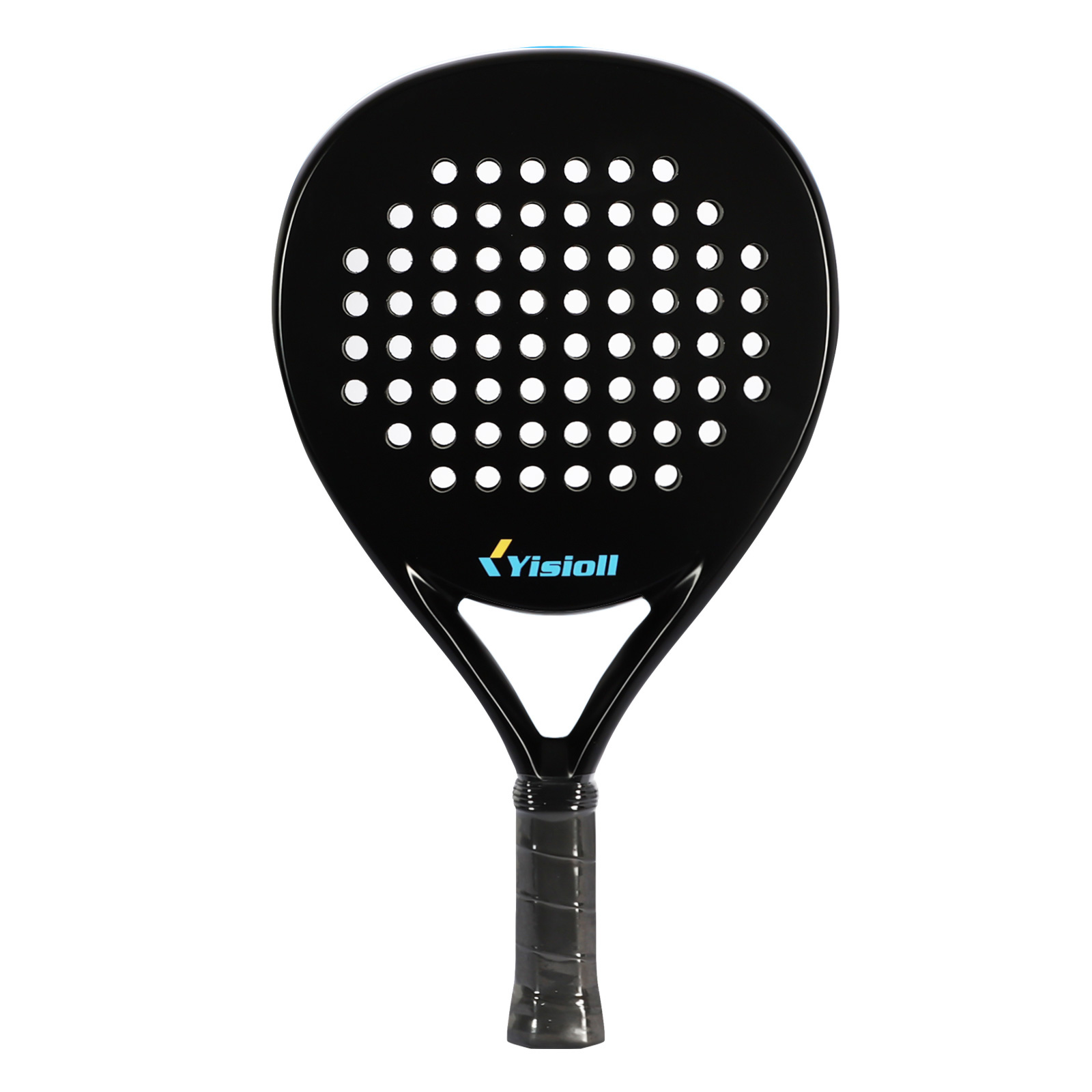
To manage the aerodynamic drag that a solid 26-centimeter-wide surface creates, manufacturers drill a precise pattern of holes through the face. These perforations stabilize the racket head. The hole pattern also influences the flexibility of the face. Denser hole groupings create a softer feel upon impact, while fewer holes maintain structural rigidity.
The structural integrity of a padel racket depends heavily on its outer perimeter. A full carbon fiber racket frame provides the essential torsional stability required for modern play. When you hit the ball off-center, the racket naturally wants to twist in your hand. A rigid carbon tubular frame resists this torsion. It ensures the racket face remains stable and energy transfers efficiently into the ball rather than dissipating through unwanted vibration.
This engineering requirement differs significantly from tennis. While tennis racquets also utilize carbon layups, padel frames face unique environmental hazards. Padel is played inside an enclosed court. Your racket frequently collides with tempered glass walls and metallic mesh fencing during defensive digs. Carbon fiber offers the superior tensile strength needed to withstand these high-velocity impacts. It prevents catastrophic structural failure far better than cheaper fiberglass alternatives.
The transition from entry-level to advanced equipment is largely defined by the padel racket face material. Fiberglass is commonly used in beginner models because it is highly elastic. This elasticity creates a pronounced trampoline effect, generating easy power for players with slow swing speeds. However, as you advance, fiberglass becomes a liability. It flexes too much under heavy impact, leading to a loss of control and energy dissipation during aggressive shots.
Carbon fiber serves as the performance benchmark for competitive players seeking speed, stability, and a lighter overall swing weight. Because carbon fiber flexes less upon impact, it provides a highly consistent hitting surface. This rigidity delivers a direct, immediate response. When executing overheads like bandejas, viboras, and flat smashes, a carbon face ensures that the energy generated by your swing transfers directly into ball speed without the mushy energy drop-off associated with fiberglass.
When evaluating a carbon fiber padel racket, you inevitably encounter "K" ratings. The "K" stands for thousands, indicating the number of individual carbon filaments bundled into a single thread before weaving. For example, a 3K weave contains 3,000 filaments per thread, while a 24K weave contains 24,000.
A common misconception is that a higher K-rating automatically equals a stiffer racket. The reality of padel manufacturing is more complex. Higher K numbers often result in a denser, heavier thread. Depending on how flat the manufacturer weaves these thicker threads and the specific epoxy resin used to bind them, a 24K face can sometimes feel more flexible and forgiving than a tightly woven 3K face. The K-rating dictates the density and weight of the face material, which interacts directly with the underlying EVA foam to determine the racket's overall responsiveness.
Carbon Weave (K-Rating) | Filament Count | General Characteristics | Best Suited For |
|---|---|---|---|
3K Carbon | 3,000 per thread | Tightly woven, highly rigid, lighter weight. Provides a very dry, crisp feel on impact. | Aggressive players wanting maximum control and absolute power on smashes. |
12K Carbon | 12,000 per thread | Medium density. Balances rigidity with a slight increase in flexibility depending on the resin. | Versatile players looking for a mix of ball output and structural stability. |
18K / 24K Carbon | 18,000+ per thread | Thicker threads, often woven flatter. Can feel softer than 3K if paired with flexible resin. | Players wanting the durability of carbon with a slightly more forgiving sweet spot. |
Understanding the distinction between easy power and absolute power is critical when selecting equipment. Easy power, often referred to as ball output (salida de bola), describes how fast the ball rebounds off the racket with minimal physical effort from the player. Fiberglass faces and low-density foam cores excel at easy power. They are ideal for blocking fast shots at the net or executing defensive lobs from the back of the court where you have no time for a full swing.
Absolute power refers to the maximum velocity you can generate during an aggressive, full-force swing, such as a kick smash. Rigid carbon fiber excels at absolute power. Because the material does not over-compress, it rewards advanced technique and fast swing speeds with pinpoint control and maximum velocity. Stiffer carbon fiber requires your physical power to compress the ball. If a beginner uses a rigid carbon racket and swings slowly, the ball will simply drop short into the net. Furthermore, unlike tennis where you can adjust string tension post-purchase to tweak power levels, a padel racket's performance profile is permanently locked in at the factory.
The shape of the racket interacts directly with the stiffness of the carbon fiber to dictate the size and location of the sweet spot. Padel rackets generally fall into three shape categories, each demanding a different level of technical proficiency:
Round Shape: Features a low balance point near the handle and a large, centrally located sweet spot. When paired with carbon fiber, it offers maximum control and maneuverability. This is the ideal starting point for transitioning tennis players.
Teardrop (Drop) Shape: Features a medium balance point and a sweet spot located slightly higher on the face. It provides a versatile mix of power and control, suited for all-court players.
Diamond Shape: Features a high balance point (head-heavy) and a small sweet spot located near the top edge. This maximizes leverage for overheads but severely punishes off-center hits.
A rigid carbon diamond racket offers the smallest sweet spot of all configurations. Striking the ball outside this zone results in a dead feel and significant vibration. This demands high precision from the player, contrasting sharply with the forgiving nature of an oversized tennis racquet. Tennis players must adapt to finding this smaller, higher sweet spot to maximize their attacking shots.
The shock absorption properties of a racket depend on the pairing of the carbon face with the internal foam core. Carbon fiber is inherently stiff and transmits impact vibrations down the shaft and into your arm. To mitigate this, manufacturers pair stiff carbon faces with varying densities of EVA foam.
Transitioning tennis players face a high risk of developing tennis elbow if they select an overly stiff carbon racket without possessing the requisite stroke mechanics to absorb the impact. In tennis, long strokes dissipate the shock over a longer kinetic chain involving the legs, hips, and torso. In padel, the strokes are compact and abrupt. Quick volleys often isolate the forearm and wrist. Hitting a heavy ball with a stiff racket using only the forearm sends shockwaves directly into the lateral epicondyle. Players with joint sensitivity should look for carbon frames that incorporate anti-vibration technologies in the bridge or utilize a softer polyethylene core to absorb the harsh frequencies generated by off-center hits.
Before investing in premium equipment, transitioning players must evaluate how their existing mechanics translate to the enclosed court. Tennis mechanics rely on long, loopy groundstrokes generated from the baseline. Padel mechanics require compact, block-style volleys and short, precise defensive pushes off the back glass.
Material pairings should be recommended based on swing length. Players who still use long tennis swings in padel will benefit from softer faces. Fiberglass or low-K carbon absorbs some of the excess energy and keeps the ball in the court. Conversely, players who have successfully adapted to aggressive, fast, and compact padel swings require rigid carbon. A soft racket under a fast swing will result in a mushy feel, where the core bottoms out and the ball loses velocity and directional accuracy.
The padel market offers a wide spectrum of pricing based on material composition. Hybrid rackets, which feature a carbon frame paired with a fiberglass face, offer a practical entry point. They provide the structural durability of a carbon frame against wall impacts while maintaining the forgiving, easy-power characteristics of fiberglass on the face.
Investing in a 100% Padel Racket built entirely of carbon fiber represents a significant step up in performance. Beginners will likely not extract the return on investment from a premium 18K carbon racket because they lack the swing speed to activate the material's absolute power. Intermediate-to-advanced players require full carbon for its superior resistance to wear and tear, lighter overall weight, and unmatched shot consistency during high-speed rallies.
A critical reality that tennis players must accept is that padel rackets have a significantly shorter competitive lifespan than tennis racquets. While a tennis frame can last for years with regular restringing and bumper guard replacements, a padel racket typically lasts between 6 to 12 months for frequent players.
This limited lifespan is due to core degradation and structural fatigue. Every impact compresses the EVA foam. Over thousands of hits, the foam loses its memory and ability to rebound, resulting in a dead spot in the center of the racket. Furthermore, frequent impacts with the glass walls and metal fencing create micro-fractures in the carbon fiber frame. While carbon remains significantly more resistant to wear and tear than fiberglass, these micro-fractures eventually compromise the structural integrity, leading to a cracked face or a snapped bridge.
Unlike a tennis racquet, a carbon padel racket is highly sensitive to ambient temperature fluctuations. The environmental temperature directly alters the physical properties of the EVA core and the composite face.
In high heat, the EVA core softens and expands. This increases the racket's bounce but drastically reduces control, making the racket feel overly springy. In cold weather, the materials stiffen. The core contracts and hardens, reducing power output and increasing the amount of vibration transmitted to the arm. Carbon fiber is inherently more consistent across these temperature fluctuations compared to fiberglass, which can become highly erratic and overly soft in extreme heat.
To mitigate these environmental risks, you must implement strict maintenance habits:
Never leave your racket in the trunk of a car, as extreme heat will permanently deform the EVA foam.
Utilize thermal racket bags lined with foil to regulate the temperature of the equipment before play.
Maintain two identical rackets with different core densities: a harder EVA core for summer play to maintain control, and a softer core for winter play to compensate for the cold-induced stiffness.
Apply a polyurethane frame protector tape to the top edge to absorb minor scrapes against the glass and fencing.
To finalize your transition from tennis to padel, you must take immediate, practical steps to secure the right equipment. Follow these action-oriented next steps to ensure your gear matches your developing mechanics:
Test three different racket shapes (Round, Teardrop, Diamond) on the court to physically evaluate how the fixed balance points affect your volley speed.
Purchase a round-shaped racket with a medium-density EVA core and a 3K carbon face as your first serious upgrade to balance control with structural durability.
Manually build up your padel grip by applying two to three overgrips until the handle matches the exact thickness of your preferred tennis grip.
Invest in a foil-lined thermal racket bag immediately to protect the internal foam core from temperature-induced degradation.
A: The primary differences are the lack of strings, a shorter maximum length of 45.5cm, and a solid perforated face. Instead of a string bed, padel rackets use an EVA or Polyethylene foam core encased in composite materials like carbon fiber or fiberglass to generate power and control.
A: Carbon fiber is lighter, offers higher durability, and provides a stiffer feel for better control. It maintains more consistent performance across different temperatures compared to fiberglass. However, carbon fiber requires better technique and faster swing speeds to unlock its absolute power potential.
A: Spin in padel is primarily generated by your brushing motion and the surface roughness of the racket face, rather than the snap-back effect of tennis strings. While 3D decals or sandy finishes on the carbon face help grip the ball, technique remains the dominant factor for spin.
A: While the carbon frame is highly resistant to wear and tear, the internal foam core degrades with use. A padel racket typically lasts 6 to 12 months for regular players before losing its responsiveness, whereas a tennis frame can last years with regular restringing.
A: The K-rating defines the number of carbon filaments per thread. For example, 3K means 3,000 filaments. This rating impacts the density, weight, and flexibility of the racket face. Higher K ratings generally mean denser threads, which interact with the resin to alter the racket's stiffness.
A: Padel rackets come with a standard, relatively small grip size direct from the factory. You cannot buy different base grip sizes like in tennis. Instead, you must manually build up the handle using multiple overgrips to match your preferred tennis grip thickness and comfort level.